Coffee packaging must protect aroma, flavour and shelf life, but for brands selling in Europe, packaging compliance is now becoming just as important. The EU Packaging and Packaging Waste Regulation, known as PPWR, is changing how coffee roasters, importers and private-label brands evaluate packaging materials, recyclability, labelling and technical documentation.
Regulation (EU) 2025/40 entered into force on February 11, 2025 and generally applies from August 12, 2026. Not every requirement starts on the same date, but 2026 is the right time for coffee businesses to review existing packaging and prepare for the more detailed recyclability rules expected from 2030 onward.
A typical coffee bag may include several functional elements: an outer printing layer, barrier film, sealing layer, adhesive, ink, zipper and one-way degassing valve. Under PPWR, these parts should be considered as one complete packaging system rather than as unrelated components.
What PPWR Means for Coffee Packaging?
The purpose of PPWR is to reduce unnecessary packaging, improve recycling performance, increase the use of recycled materials where safe and make packaging waste easier to collect, sort and process. For coffee brands, this means that claims such as “recyclable,” “eco-friendly” or “sustainable” need to be supported by the actual packaging structure and available technical evidence.
Coffee roasters should understand their role in the supply chain. A brand using custom printed coffee bags under its own name may have responsibilities related to the finished packaging placed on the EU market. Importers and distributors may also need to confirm that the packaging complies with applicable food-contact, chemical and documentation requirements.
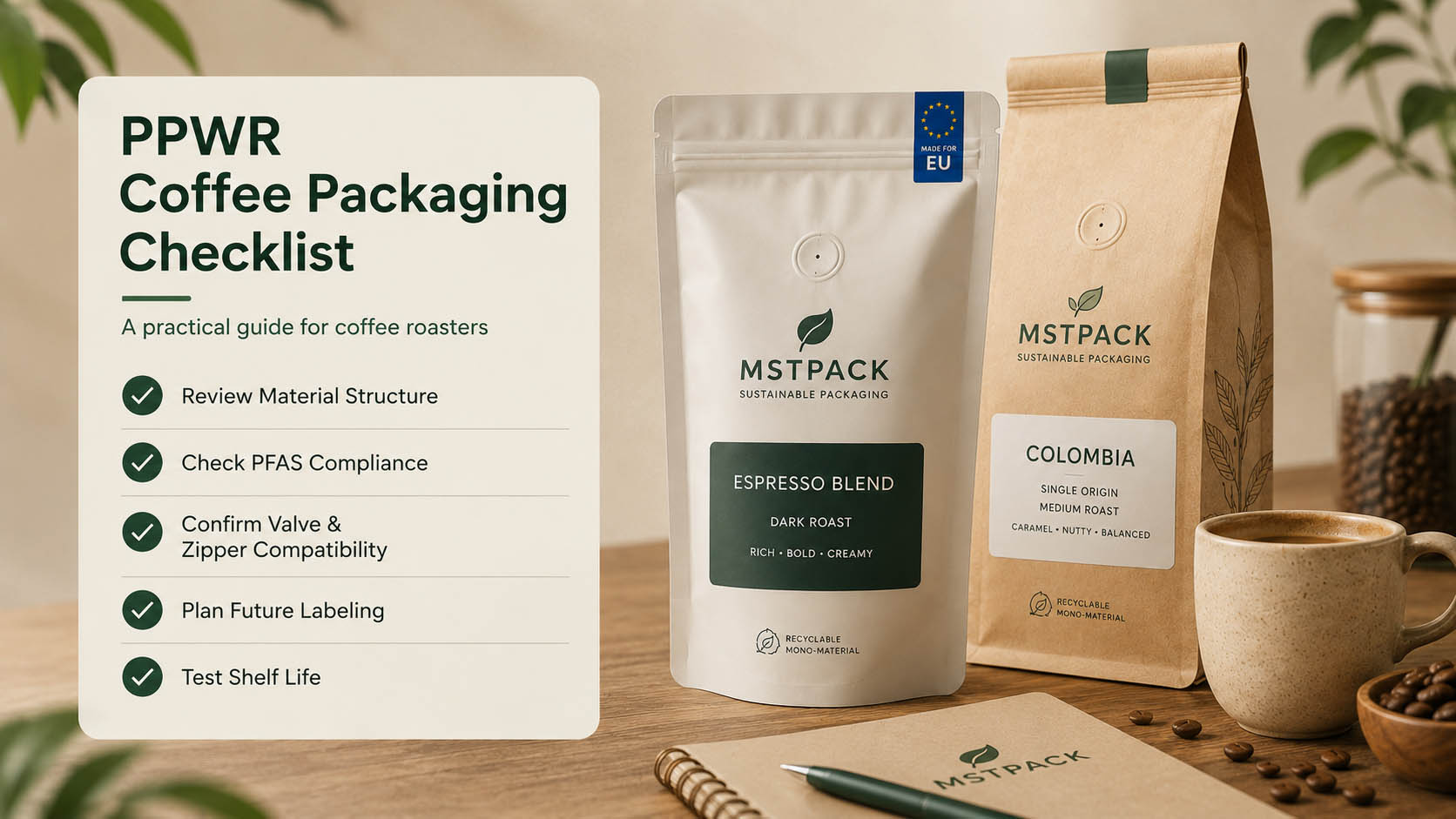
The practical impact is clear: choosing coffee packaging can no longer be based only on appearance, price and minimum order quantity. Buyers should also review the material structure, barrier performance, sealing conditions, valve compatibility, zipper material, packaging weight and end-of-life route.
Why Traditional Multilayer Coffee Bags Need Review?
Roasted coffee is highly sensitive to oxygen, moisture, light and external odours. Traditional coffee packaging often uses multilayer structures such as PET/AL/PE, PET/VMPET/PE, BOPP/VMPET/PE or paper-plastic laminates because they provide strong barrier protection.
These structures are widely used for flat bottom coffee bags, stand up coffee pouches, side gusset coffee bags and vacuum coffee packs. However, when several different materials are permanently laminated together, the finished pouch may be difficult to sort and recycle.
This does not mean every aluminium or metallised coffee bag will be banned in 2026. It means coffee brands should begin identifying which current structures may face future design-for-recycling challenges. Ink coverage, metallic layers, paper laminations, adhesives, labels, zippers and coffee valves may all affect recyclability.
The most useful first step is to request a complete specification from the coffee packaging supplier. A vague description such as “green film” or “eco material” is not enough for a compliance review.
Are Mono-Material Coffee Bags a Better Option?
Mono-material coffee packaging is one of the main solutions being considered for recyclable coffee bags. In flexible packaging, this commonly refers to PE-based structures such as PE/PE or MDO-PE/PE.
Mono-material does not always mean a single film layer. It usually means that the main layers are designed around one compatible polymer family so that the finished pouch has a better chance of being sorted and recycled in an appropriate flexible-plastic stream.
For coffee packaging, the challenge is to improve recyclability without losing barrier performance. Freshly roasted coffee continues to release carbon dioxide, while oxygen entering the bag can accelerate aroma loss and oxidation. A recyclable coffee pouch still needs reliable sealing, moisture resistance, oxygen protection and a suitable one-way degassing valve.
MDO-PE coffee packaging can offer improved stiffness, print quality and bag appearance compared with basic polyethylene film. It may be suitable for custom coffee bags, flat bottom pouches and stand up coffee bags, but the final structure should be selected according to roast level, filling method, distribution time, storage conditions and target shelf life.
A specialty coffee roaster selling locally may not need the same barrier performance as a brand exporting ground coffee through a long retail supply chain. For this reason, changing from foil packaging to mono-material PE should be tested rather than treated as a simple material replacement.
Coffee Valves and Zippers Must Also Be Considered
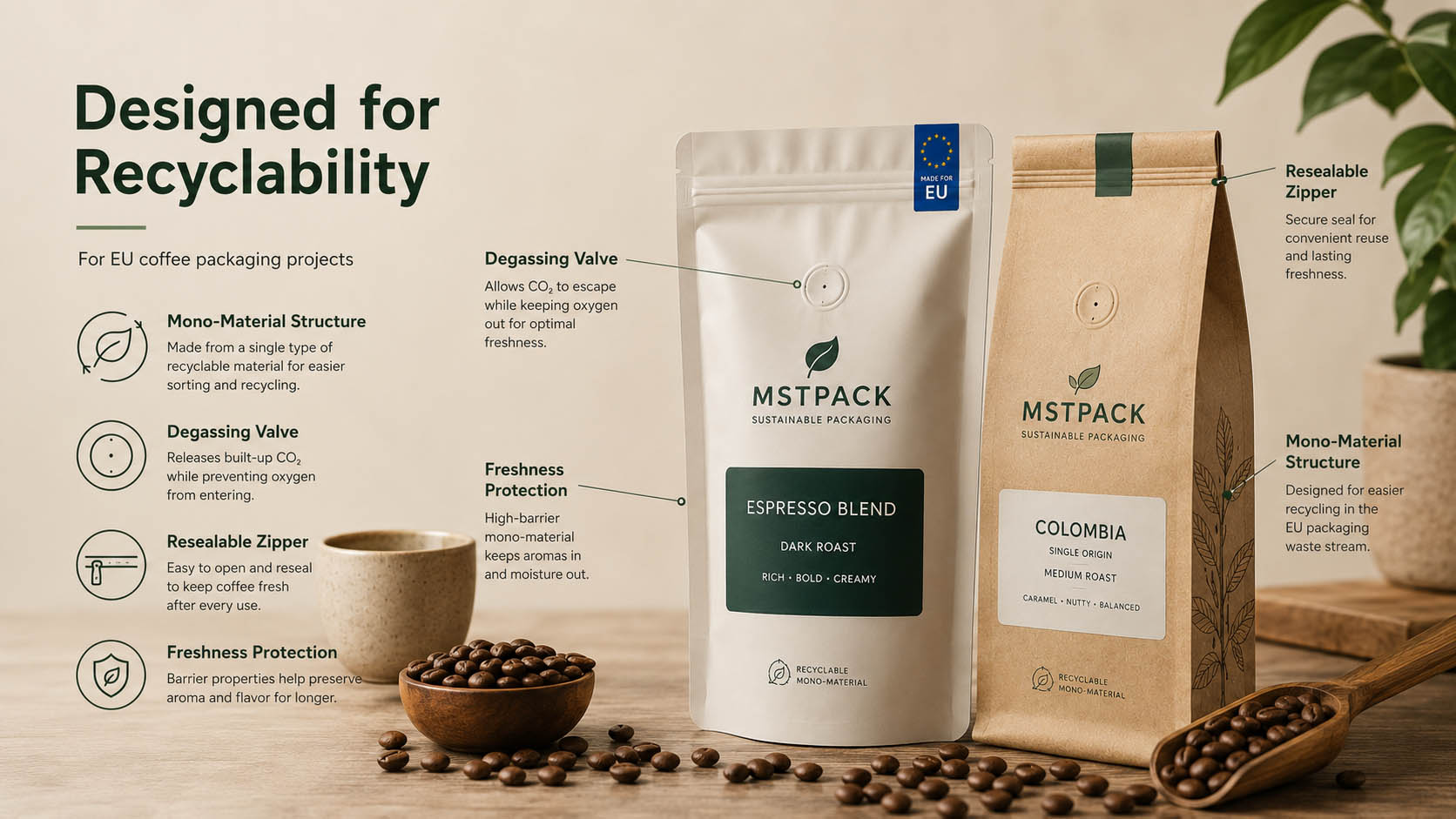
A one-way degassing valve allows carbon dioxide to escape while helping prevent outside air from entering the coffee bag. It is essential for many roasted coffee products, especially freshly roasted whole beans.
For a recyclable coffee bag with valve, the valve should be compatible with the main film family wherever possible. A PE-based valve may be more suitable for a mono-PE pouch than a component made from an unrelated plastic. However, compatibility should be assessed for the complete coffee package, including the valve body, welding method, adhesive and behaviour during recycling.
The same principle applies to resealable zippers. A PE-compatible zipper may support a mono-material coffee pouch design, while an incompatible closure can reduce overall recycling compatibility.
Coffee brands should also decide whether every pack really needs a zipper. Small sample packs and single-use coffee sachets may not require the same closure system as 250 g, 500 g, 1 kg, 12 oz or 16 oz retail coffee bags. Removing unnecessary components can reduce packaging weight and production complexity.
When a zipper is required, it should be tested with the actual product. Ground coffee can enter the zipper track during filling, so opening force, sealing reliability and powder resistance should be evaluated under real production conditions.
PFAS Requirements from August 2026
One of the most immediate PPWR issues for food-contact coffee packaging is the restriction on per- and polyfluoroalkyl substances, commonly known as PFAS.
From August 12, 2026, food-contact packaging placed on the EU market must comply with the PFAS limits set by PPWR. Coffee bags for roasted beans, ground coffee and coffee portions are food-contact packaging, so brands should review films, coatings, inks, adhesives and other processing materials used in the finished pouch.
Ordering a large quantity of coffee bags before the deadline does not automatically remove the compliance risk if the packaging is first placed on the EU market after August 12, 2026. Inventory planning is therefore important.
Coffee roasters should request relevant declarations and test evidence from their packaging manufacturer. Where testing is needed, the sample should clearly match the supplied packaging structure. A report for one film layer may not fully represent the finished printed and laminated coffee bag.
Recyclable or Compostable Coffee Bags?
Both recyclable and compostable coffee packaging can support a sustainability strategy, but they are designed for different end-of-life systems. Recyclable coffee bags are intended for an appropriate material-recycling stream. Mono-material PE coffee bags are one example, although actual collection and processing differ between EU countries.
Compostable coffee bags are designed to break down under specified composting conditions. Industrial compostable and home compostable packaging are not the same and may require different materials, certification and disposal environments.
Coffee brands should choose between these options based on the target market, local waste infrastructure, shelf-life requirement, certification need, bag format and component compatibility. The most sustainable choice is not always the material with the strongest marketing message. It is the packaging that protects the coffee, uses an appropriate amount of material and has a realistic end-of-life route.
Choosing a PPWR-Ready Coffee Packaging Supplier
A suitable coffee bag manufacturer should understand both product protection and regulatory requirements. Buyers should ask how the proposed coffee pouch protects aroma, whether the zipper and valve are compatible with the main material family, and what documentation is available.
A responsible supplier should also explain the limits of any recycling claim. No single coffee bag can be guaranteed recyclable in every European country because local collection and recycling systems differ.MSTPACK works with coffee roasters, private-label coffee brands and distributors to develop custom coffee packaging based on bag style, product protection, filling method, branding and target market. Available options include flat bottom coffee bags, stand up coffee pouches and side gusset coffee bags with custom printing, resealable zippers and one-way degassing valves.
For EU projects, material development can include mono-material PE structures, MDO-PE options, component compatibility review and barrier evaluation. Final compliance should always be confirmed against the finished specification and the regulations applicable when the packaging is placed on the market.
FAQ
1. When does PPWR apply to coffee packaging?
PPWR generally applies from August 12, 2026, but individual requirements have different timelines. PFAS limits for food-contact packaging start in 2026, while detailed design-for-recycling criteria are expected to apply from 2030 or later.
2. Will aluminium coffee bags be banned in 2026?
No general ban on all aluminium-laminated coffee bags begins in 2026. However, difficult-to-recycle multilayer structures may face increasing compliance and cost pressure as detailed recyclability rules are introduced.
3. Are mono-material PE coffee bags PPWR compliant?
Mono-material PE can support a design-for-recycling strategy, but the material name alone does not prove full compliance. The finished pouch, including barrier materials, inks, adhesives, zipper and valve, must be considered.
4. Can recyclable coffee bags still protect freshness?
Yes, when the structure is properly designed and tested. Coffee brands should verify oxygen barrier, moisture protection, seal integrity, valve performance and shelf life before changing materials.
5. Can MSTPACK Supply Recyclable Custom Coffee Bags?
MSTPACK can develop recyclable coffee packaging based on the product, bag format, barrier requirement and destination market. Options may include mono-material coffee bag structures, compatible valves and zippers, custom printing and production testing.