

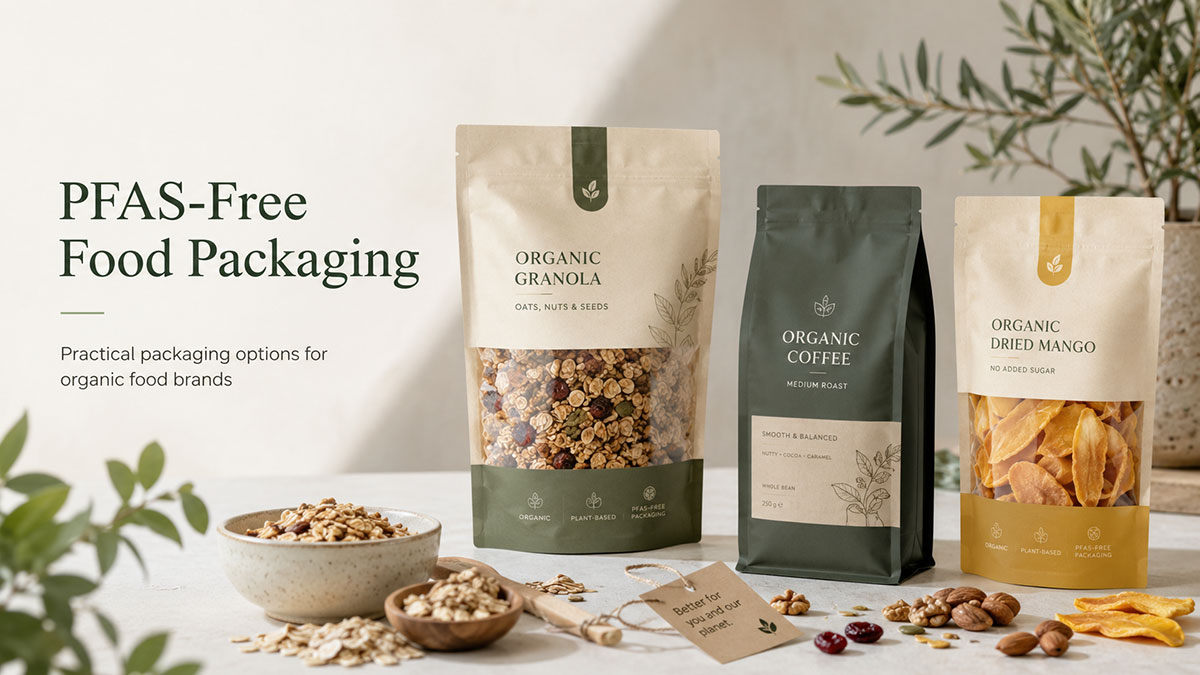
For organic food companies, packaging is becoming part of the compliance conversation rather than simply a branding or sustainability decision.
From 12 August 2026, food-contact packaging placed on the European Union market must meet the PFAS concentration limits introduced by the Packaging and Packaging Waste Regulation, Regulation (EU) 2025/40.
The requirement affects more than packaging manufacturers. Organic food producers, private-label retailers, ingredient suppliers, packaging distributors and engineering companies may all need to confirm what is used in the finished package and whether the supporting documentation is reliable.
At MSTPACK, we see one recurring problem in sustainable packaging projects: buyers often receive a broad “PFAS-free” statement without enough information to connect that statement to the actual printed pouch, rollstock film or packaging component being supplied.
A credible PPWR preparation process needs to go further.
What Does “PFAS-Free Food Packaging” Mean Under PPWR?
PFAS-free food packaging is a common commercial term, but the PPWR does not create a separate “PFAS-free certification.”
This distinction matters because “PFAS-free” should not automatically be interpreted as absolute zero under every possible laboratory method.
For purchasing specifications and technical agreements, more accurate wording would be:
The finished food-contact packaging must meet the PFAS concentration limits established under Regulation (EU) 2025/40 and be supported by appropriate supplier documentation and testing.
This is more defensible than relying on a general marketing statement.
Why Organic Food Packaging Needs Closer Review
Organic food buyers are usually careful about ingredients, sourcing and certification. Packaging, however, may involve a longer and less visible supply chain.
A finished pouch can include:
- printed outer film;
- food-contact sealant layer;
- barrier coating;
- lamination adhesive;
- inks and varnishes;
- zipper or valve;
- primers and processing aids.
Not every component presents the same level of risk, but the complete structure should be understood.
A kraft-paper appearance does not prove that a package is PFAS-free. The same applies to packaging described as recyclable, compostable, bio-based or plastic-free.
These claims address different packaging characteristics. They do not replace chemical-composition review.
For organic granola, coffee, tea, protein powder or dried fruit packaging, the first practical question should therefore be:
Does the PFAS declaration apply to the entire converted package or only one raw material?
Packaging Recommendations for Organic Food Applications
There is no universal PFAS-free film structure suitable for every organic food product.
The correct packaging depends on the food, shelf life, barrier requirement, filling process and distribution conditions.
Granola, cereals and dried food
Granola, nuts, dried fruit and cereals need reliable moisture protection and puncture resistance.
Possible formats include stand-up pouches, flat-bottom bags, side-gusset bags and form-fill-seal rollstock.
When reviewing a PFAS-conscious structure, brands should also validate seal strength, moisture barrier and resistance to sharp product edges.
Organic coffee and tea
Roasted coffee requires strong oxygen and moisture protection. Whole-bean coffee packaging may also need a one-way degassing valve.
The pouch and valve should be reviewed as one packaging system.
Changing to a recyclable or compostable construction without confirming oxygen barrier and valve compatibility can shorten shelf life or cause seal failures.
Matcha, protein powder and supplements
Powder packaging often requires high barrier performance and strong contamination-resistant seals.
Fine powder around the sealing area can reduce seal integrity, so film selection should consider filling speed, seal initiation temperature and zipper design in addition to PFAS documentation.
Frozen organic food
Frozen-food packaging must remain flexible at low temperatures and resist puncture, cracking and seal failure.
A structure that performs well at room temperature may behave differently during freezing, cold storage and transport.
Freezer testing and filled-pack trials are therefore essential when changing materials.
Snacks and confectionery
Snack and confectionery products may use premade pouches, pillow bags, flow-wrap films or cold-seal rollstock.
The correct construction should balance machinability, oxygen or moisture protection, seal quality and packaging reduction requirements.
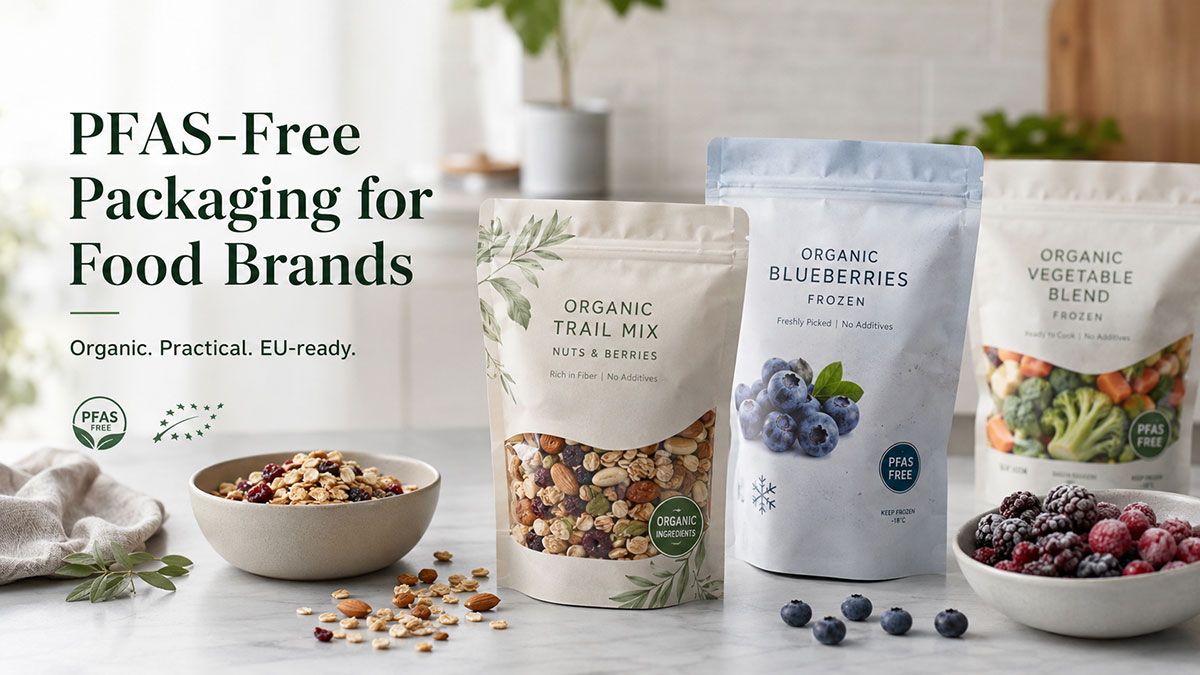
PFAS Compliance Is Not the Same as Recyclability
This is an important distinction for sustainability teams.
A package that meets the PPWR PFAS limits is not automatically recyclable.
A mono-material pouch is also not automatically PFAS-compliant.
A well-planned redesign should consider all five areas together: PFAS restriction, food-contact safety, recyclability, packaging minimisation, and product protection.
Reducing packaging weight but increasing product damage or food waste is not a successful packaging improvement.
How MSTPACK Approaches PFAS-Conscious Packaging Projects
MSTPACK manufactures custom flexible packaging for coffee, tea, snacks, frozen food, powders, granola, pet food and other food applications.
Our work on PFAS-conscious packaging begins with the product rather than with a material claim.
Before recommending a structure, we review:
- the food type and fill weight;
- expected shelf life;
- oxygen and moisture sensitivity;
- storage and transport conditions;
- filling and sealing method;
- existing film structure;
- zipper, valve or window requirements;
- target EU market;
- required documentation;
- annual quantity and SKU plan.
This helps avoid a common packaging mistake: selecting a material because it sounds more sustainable, then discovering that it does not provide the required barrier, seal strength or machine performance.
For organic food companies, packaging agents and engineering partners, early technical discussion is usually more valuable than requesting a price based only on bag dimensions.
Frequently Asked Questions
When do the PPWR PFAS limits apply?
The limits apply to food-contact packaging placed on the EU market from 12 August 2026.
Is paper food packaging automatically PFAS-free?
No. Coatings, barrier treatments, inks and adhesives should still be reviewed.
Are compostable food pouches exempt?
No general exemption applies simply because a package is compostable, biodegradable or plant-based.
Is recyclable packaging automatically PFAS-free?
No. Recyclability and PFAS concentration are separate compliance considerations.
Does “not detected” mean the package complies?
Only when the analytical method, substance scope and detection limits are suitable for assessing the applicable thresholds.
Should buyers test the finished packaging?
For printed and laminated flexible packaging, the finished commercial construction is usually more representative than one raw film.
For organic food companies, PFAS preparation should not begin and end with a supplier statement.
The more reliable approach is to understand the complete package, define the applicable requirements, confirm representative evidence and test any revised structure under real filling and distribution conditions.
A food package must meet chemical requirements, but it must also protect the product, run reliably and support the brand’s wider sustainability objectives.
Planning a PFAS-conscious food packaging project for the EU?
Send MSTPACK your current packaging structure, product type, target shelf life, filling conditions and estimated order volume. Our packaging team can help review suitable pouch or rollstock options and identify the technical information needed before sampling and production.
This article provides general packaging guidance and does not constitute legal advice. Requirements should be confirmed for the specific packaging, food product and EU market involved.