

How to Choose Dog Food Packaging Bags That Actually Work
Dog food packaging looks simple from the outside, but it is one of the more demanding categories in flexible packaging.
A good dog food bag must hold weight, resist puncture, protect oils and aroma, survive transport, stand well on the shelf, and still look attractive enough for pet owners to trust the brand. If the bag is too thin, the zipper fails, the seal area leaks, or the barrier is not strong enough, the problem usually appears after filling, shipping, or storage — when it is already expensive to fix.
At MSTPACK, we work with pet food brands on packaging for dry kibble, dog treats, freeze-dried food, pet supplements, functional toppers, and premium nutrition products. From our experience, most packaging problems come from choosing the bag only by appearance or price, instead of matching the structure to the product.
This guide explains how to select dog food packaging bags based on four key points:
bag size, film strength, barrier protection, and material structure.
Why Dog Food Packaging Needs More Than a Nice Design
Dog food is usually heavier, oilier, and more abrasive than many snack products. Dry kibble can create pressure points inside the bag. Meat-based treats may contain fat and aroma compounds. Freeze-dried products are light but highly moisture-sensitive.
That means dog food packaging has to do more than carry branding.
It needs to protect against:
- oxygen exposure
- moisture absorption
- grease migration
- aroma loss
- light damage
- seal failure
- bag tearing during handling
- damage during carton packing and shipping
For pet owners, packaging also affects trust. A strong, clean, well-sealed pouch gives the feeling that the product is fresh and professionally made. A weak bag, broken zipper, oily surface, or poor shelf shape can make even a good product look unreliable.
The global pet food market also makes packaging more important. According to industry data from APPA, U.S. pet industry spending reached over USD 150 billion in 2025 and is expected to keep growing. In Europe, FEDIAF reports millions of tonnes of pet food sold every year. As competition increases, packaging becomes one of the fastest ways for brands to show quality, freshness, and differentiation.
1. Start With the Right Bag Size
The first question is not “What size is popular?”
The better question is:
How much volume does your product need after filling, sealing, and shipping?
Dog food density varies a lot. A 1kg bag of small dry kibble does not take the same space as a 1kg bag of freeze-dried chicken cubes. Treats, air-dried meat strips, and functional toppers also have different volume requirements.
Before confirming the final bag size, MSTPACK usually checks five points with customers product density, headspace, shelf display, carton packing, and consumer handling.
2. Choose a Bag Style That Matches the Sales Channel
Different dog food products need different bag styles. The right choice depends on product weight, shelf position, filling method, and brand image.
Stand Up Pouch
Stand up pouches are widely used for dog treats, small dry food packs, freeze-dried food, and pet supplements. They are cost-effective, easy to display, and suitable for zipper, tear notch, window, and hang hole options.
Flat Bottom Bag
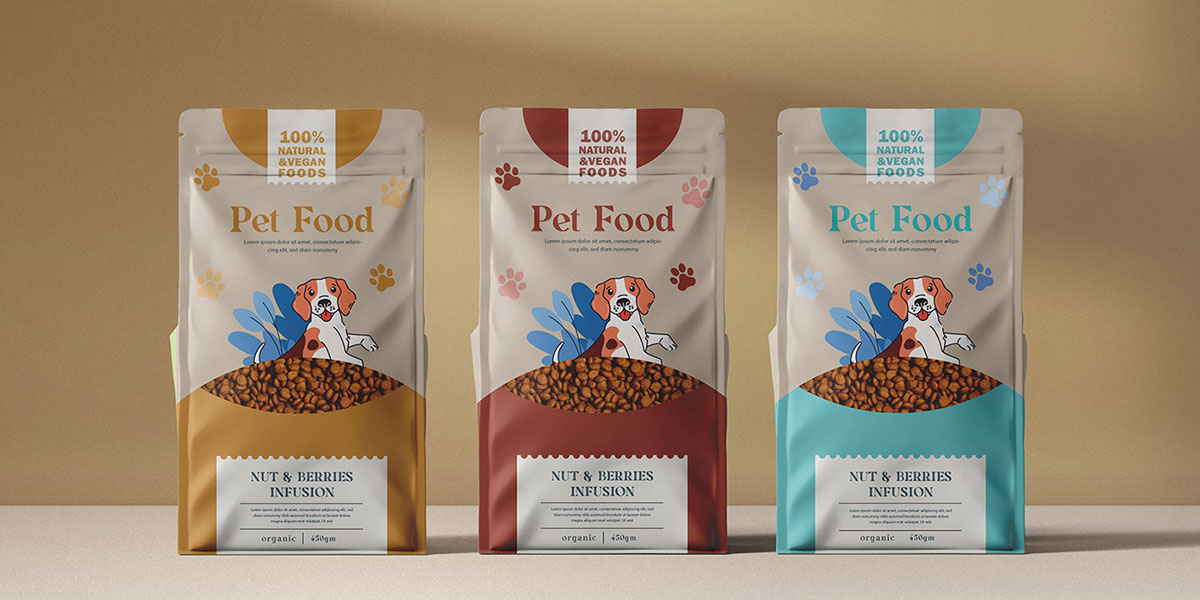
Flat bottom bags are popular for premium dog food because they stand neatly and provide five printable panels: front, back, two sides, and bottom. This format gives brands more space for product story, ingredients, feeding guidance, and certifications.
Quad Seal Bag
Quad seal bags use four vertical seals to create a stronger, more structured package. They perform well for medium and large fill weights and are suitable for retail or warehouse channels.
Side Gusset Bag
Side gusset bags provide high filling volume and good stacking efficiency. They are commonly used for bulk dry dog food and large pet food formats.
Spout Pouch
Spout pouches are suitable for wet dog food, liquid pet nutrition, broth toppers, gravy, sauce-based pet food, and functional liquid supplements.
Vacuum Pouch
Vacuum pouches are used when oxygen removal is important for freshness, color, aroma, or shelf-life protection. They are especially suitable for fresh pet food, cooked meat-based dog food, refrigerated pet meals, high-protein treats, and certain raw or semi-moist pet food products.
3. Film Strength: The Part Many Brands Underestimate
Dog food bags need higher mechanical strength than many standard food pouches. Kibble can be heavy and sharp-edged. During filling and transport, the bag may face dropping, compression, vibration, and stacking pressure.
When MSTPACK develops dog food packaging, we pay close attention to these strength factors, such as film thickness, seal strength, puncture resistance, drop resistance, and handle strength.
4. Barrier Performance: Protecting Freshness, Fat and Aroma
Dog food often contains fats, oils, meat ingredients, flavor coatings, vitamins, and natural aromas. These components are sensitive to oxygen, moisture, and light.
A packaging material that works for simple dry snacks may not be enough for premium dog food.
5. Zipper, Window, Handle and Other Functional Details
Small functional details often decide whether customers like using the package.
Resealable Zipper
A zipper is strongly recommended for most dog food bags below 5kg. It helps consumers close the package after opening and improves storage convenience.
Tear Notch
A tear notch makes the bag easier to open. For thick or high-barrier structures, the tear direction should be tested to avoid rough opening.
Transparent Window
A window helps show real product texture, especially for dog treats and freeze-dried products. But the window also reduces light protection in that area. It should be used carefully for products sensitive to oxidation or light.
Hang Hole
Hang holes are useful for small dog treat packs displayed on retail hooks. The hole position must avoid weakening the zipper or top seal.
Handle
A handle is helpful for medium and large dog food bags. Options include die-cut handles, reinforced handles, and side handles. For large bags, handle strength should be tested with filled product.
6. Recyclable and Sustainable Dog Food Packaging
Many pet food brands are looking for more sustainable packaging. This is a positive direction, but dog food packaging cannot ignore barrier and strength.
A recyclable bag still needs to protect the product. A paper-look bag still needs to resist grease. A compostable bag still needs to pass shelf-life and sealing tests.
MSTPACK supports several sustainable packaging directions for pet food brands, including recyclable dog food bags, kraft paper dog food bags, PCR packaging options, and compostable dog food bags.
Do not choose sustainable packaging only for marketing. Choose it when the structure can still meet freshness, strength, shelf life, filling, and local disposal requirements.
7. Printing and Design: What Pet Owners Need to See Quickly
Dog food packaging design should be attractive, but it also needs a clear information hierarchy.
For export markets, packaging should also reserve space for local labeling and regulatory information.
MSTPACK supports both digital printing and rotogravure printing.
Digital printing is suitable for small batches, multiple SKUs, market testing, and fast design changes.
Rotogravure printing is suitable for larger orders, stable repeat production, and premium color consistency.
For pet food brands with several flavors or formulas, MSTPACK can help plan a consistent packaging system across different SKUs.
8. Compliance: Leave Space for Required Label Information
Dog food packaging must carry more than brand visuals. In markets such as the United States and Europe, pet food labels usually need product identity, species suitability, net weight, ingredients, nutritional information, feeding instructions, manufacturer or distributor details, and other required information.
Packaging suppliers do not replace regulatory consultants, but a professional packaging supplier should understand where the label information needs to fit and how printing, materials, and finishes affect the final package.
MSTPACK recommends confirming label content before final artwork approval, especially for export pet food packaging.
Dog food packaging bags should be selected by product performance, not only by appearance. The right bag needs to match the fill weight, product density, oil content, shelf life, sales channel, and brand positioning.
For small dog treats, a stand up pouch with zipper may be the most practical choice. For premium dry dog food, a flat bottom bag with high-barrier laminate can improve shelf presence and freshness protection. For large dry dog food, strength, seal integrity, puncture resistance, and drop performance are the main priorities.
MSTPACK helps pet food brands develop custom dog food packaging bags from material structure and bag size to printing, zipper, handle, window, and sustainable options.
If you are developing new packaging for dog food, treats, freeze-dried food, or pet nutrition products, MSTPACK can help you choose a structure that protects the product, supports your brand, and performs in real distribution conditions.
FAQ
What is the best bag for dry dog food?
For small dry dog food packs, stand up pouches and flat bottom bags are common choices. For medium and large dry dog food, quad seal bags and side gusset bags offer better strength and stability. The best option depends on fill weight, product density, barrier needs, and sales channel.
What material is used for dog food packaging bags?
Common dog food packaging materials include PET/PE, PET/VMPET/PE, PET/AL/PE, kraft paper laminates, NY/PE, and PE-based recyclable structures. High-fat or long-shelf-life products usually need stronger oxygen and moisture barrier.
Do dog food bags need high barrier film?
Many dog food products need barrier protection because they contain fats, oils, meat ingredients, or flavor coatings. High-barrier film helps reduce oxygen, moisture, light, and aroma loss, especially for premium, freeze-dried, or export products.
Can dog food packaging bags be recyclable?
Yes. PE-based recyclable dog food packaging can be developed for selected products. However, the structure should be tested for strength, sealing, oxygen barrier, moisture barrier, and shelf-life performance before mass production.
Should dog food bags have a zipper?
A zipper is recommended for most small and medium dog food bags because consumers need to reseal the package after opening. For heavier bags, a wider zipper or slider zipper may improve convenience.
What bag style is best for premium dog food?
Flat bottom bags are often used for premium dog food because they stand well, look structured, and provide more printable panels for branding and product information.
How do I choose the right size for dog food packaging?
The right size depends on product weight, density, headspace, zipper position, sealing area, shelf display, and carton packing. MSTPACK recommends testing the actual product before confirming final dimensions.