
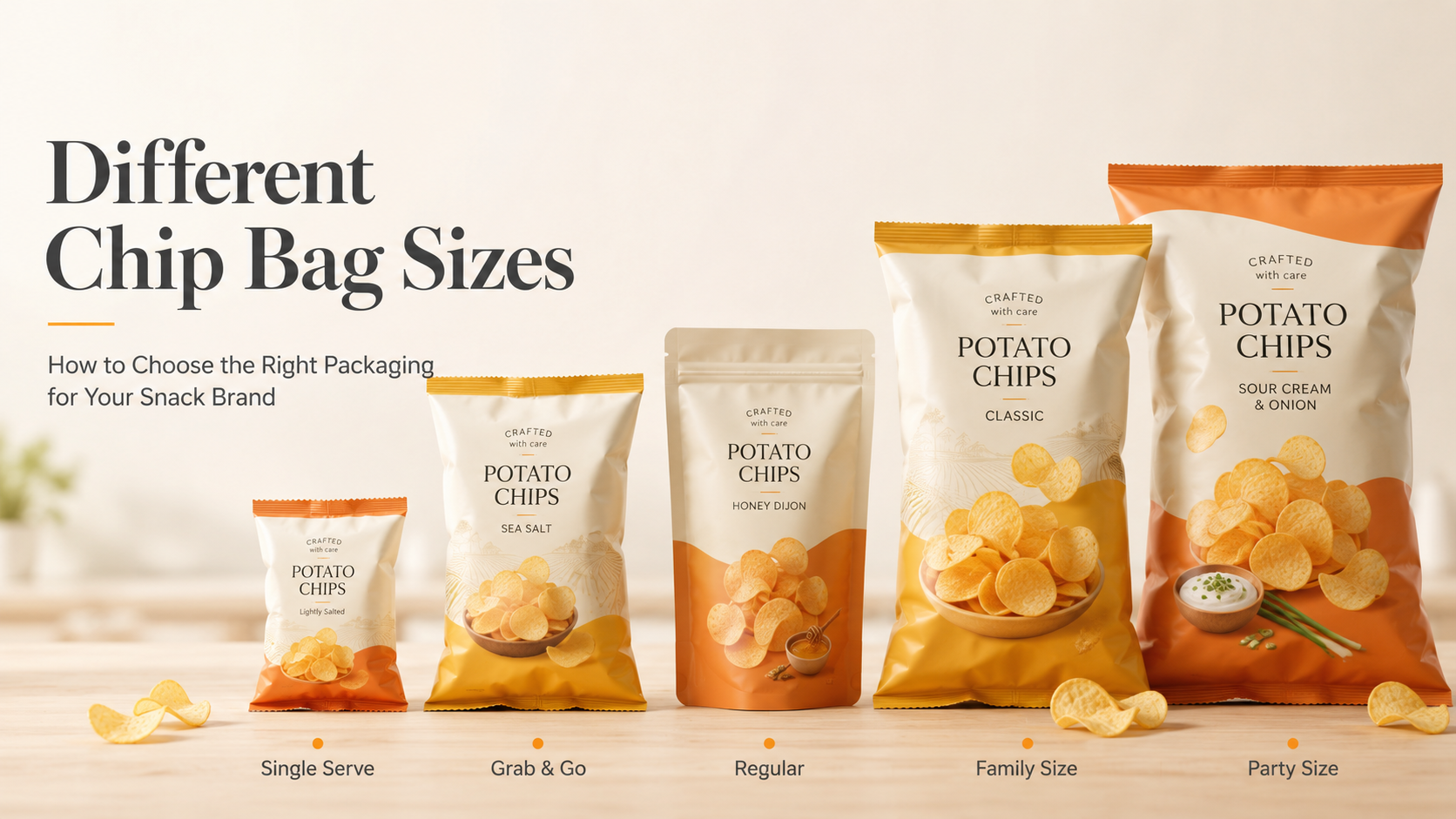
A 1 oz chip bag may work well for vending machines, school snacks or sample packs, while a larger party-size chip bag is designed for sharing, retail promotion and family consumption. In today’s snack market, brands often need more than one size to cover different sales channels and consumer occasions.
At MSTPACK, we help snack brands develop custom chip packaging bags based on product weight, filling method, shelf life target, branding needs and retail channel requirements.
Why Chip Bag Size Matters for Snack Brands
Chip bag size plays an important role in both packaging performance and marketing strategy. A small chip bag gives consumers convenience and portion control. A medium bag supports daily retail sales. A family or party-size bag improves value perception and works well for supermarkets, club stores and social occasions.
Common market references usually divide chip bags into personal size, regular size, family size and party or bulk size. Personal bags are often around 1–2 oz, while larger party packs may reach 13–16 oz or more depending on the brand and market. Some bulk or club-store formats can be even larger.
For brands, this means packaging should not be selected only by product weight. The bag size must match the product positioning, target customer, distribution channel and expected eating occasion.
Common Different Chip Bag Sizes
1. Single-Serve Chip Bags
Single-serve chip bags are usually designed for individual consumption. They are commonly used for lunch boxes, vending machines, convenience stores, school snacks, airline snacks, promotional samples and variety packs. Typical weight range: 1 oz to 2.5 oz / about 28 g to 71 g .This size is suitable for brands that want to offer portion-controlled snacks or create trial packs for new flavors. Single-serve bags also help reduce product waste because the consumer finishes the product in one occasion.
For packaging production, single-serve chip bags are often made as pillow bags, three-side seal bags or small flat pouches. They require excellent sealing performance because the packaging area is small and the filling speed is usually high.
2. Regular Chip Bags
Regular chip bags are the most common retail size for daily snacking. They are often seen in supermarkets, grocery stores, convenience stores and online snack bundles. Typical weight range: 5 oz to 10 oz / about 140 g to 283 g. This size works well for individual consumers, couples or small households. It gives brands enough front-panel space for logo, flavor name, product image, nutrition callouts and sustainability messages.
For custom chip packaging, this size is suitable for high-impact printed rollstock, pillow bags or stand-up pouches depending on the product and filling equipment.
3. Family Size Chip Bags
Family size chip bags are designed for home sharing and repeated use. Compared with regular bags, they usually carry more product and may require stronger film structure, better sealing strength and sometimes a resealable feature.Typical weight range: 9 oz to 12 oz / about 255 g to 340 g
Family-size packaging is useful for brands selling through supermarkets, warehouse channels and e-commerce. Because the bag is larger, shelf impact becomes more important. A clear brand block, bold color system and easy-to-read flavor information can help improve visibility.
For premium or better-for-you snack brands, a family-size chip bag can also support kraft paper texture, matte finish, recyclable mono-material film or high-barrier laminated film.
4. Party Size Chip Bags
Party-size chip bags are made for sharing occasions such as family gatherings, office snacks, game nights, picnics and events. Typical weight range: 13 oz to 16 oz / about 368 g to 453 g. Many packaging guides identify 13–16 oz as a common range for party or mega-size chip bags.
For this size, packaging strength becomes more important. The bag must withstand larger filling volume, retail handling, transportation pressure and consumer storage after opening. Brands may also consider a wider front panel, stronger seals and high-barrier materials to protect crispness.
5. Bulk or Club-Store Chip Bags
Bulk chip bags are often used for warehouse retail, foodservice, catering, wholesale supply and large family consumption. Typical weight range: 18 oz to 30 oz / about 510 g to 850 g.
These bags are not only bigger in volume but also more demanding in material structure. Large chip bags need strong puncture resistance, high oxygen and moisture barrier, stable sealing and good machine compatibility.
For exporters or private-label snack brands, bulk chip packaging can be customized according to carton size, pallet loading, shelf display and customer distribution standards.
How Brands Should Choose the Right Chip Bag Size?
Start with Product Weight and Chip Shape
Different snack products have different bulk density. Thin potato chips, kettle chips, tortilla chips, popped chips and vegetable chips do not fill the same volume even at the same weight. A 100 g kettle chip product may require a different bag size than a 100 g thin potato chip product. Before confirming the final size, brands should test actual filling volume instead of only calculating by weight.
Match the Size with Sales Channel
A convenience store snack needs a compact, easy-to-grab package. A supermarket shelf pack needs stronger visual impact. An e-commerce snack pack needs better transport protection. A foodservice pack needs cost efficiency and durability. For example, single-serve bags may work well for vending and sampling, while family-size or party-size bags are more suitable for supermarkets and group consumption.
Consider Packaging Material and Barrier
Chip packaging must protect against moisture, oxygen, oil migration, light and odor transfer. For standard potato chips, high-barrier laminated film is commonly used. For brands that focus on sustainability, recyclable mono-material structures or paper-based flexible packaging may also be considered, depending on shelf-life requirements.
MSTPACK can support different material options, including high-barrier film, matte or glossy laminated film, recyclable PE-based structures, kraft paper appearance, aluminum-free structures and custom printed rollstock for automatic filling lines.
If you are developing custom chip bags for potato chips, tortilla chips, popped snacks or other crispy snack products, MSTPACK can help you design the right size, structure and material for your market.
Contact MSTPACK to create custom chip packaging bags for your snack brand.
FAQ: Different Chip Bag Sizes
What are the most common chip bag sizes?
Common chip bag sizes include single-serve bags around 1–2.5 oz, regular retail bags around 5–10 oz, family-size bags around 9–12 oz and party-size bags around 13–16 oz. Larger bulk formats may reach 18–30 oz depending on the channel and brand.
What is the best chip bag size for a new snack brand?
For a new snack brand, a regular retail size plus a small sample size is often a practical starting point. If the product is designed for sharing, a family-size bag can also be added.
Can chip bag sizes be customized?
Yes. Chip bag sizes can be customized based on product weight, filling volume, bag style, shelf-life target, printing design and packing machine requirements.
What packaging format is best for potato chips?
Pillow bags made from printed rollstock are widely used for high-speed chip packaging. Stand-up pouches and flat bottom bags are also suitable for premium or resealable snack products.
Why do chip bags need extra space inside?
Chip bags often need headspace to protect fragile chips from breakage and to allow nitrogen flushing for freshness protection.